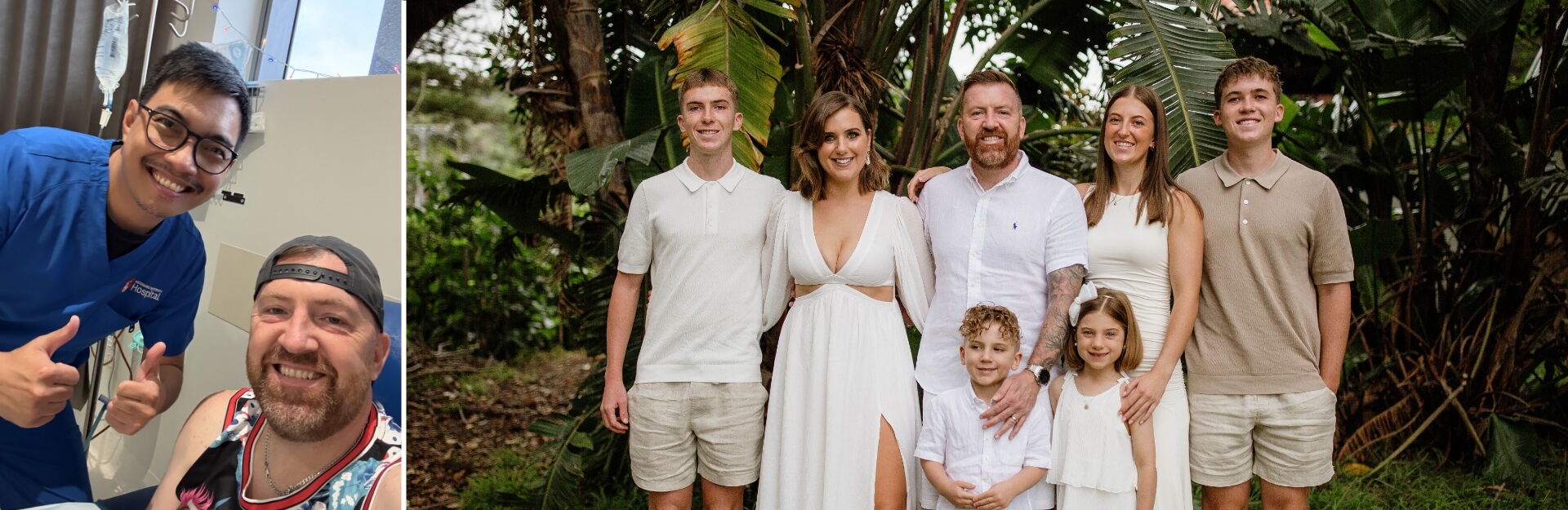
My name is David, I’m 46, married to my beautiful wife Emily and a very proud dad to five amazing kids. Family is everything to me.
On 2 December 2024, at the age of 44, I was diagnosed with Stage IV bowel cancer (sigmoid colon cancer). By the time it was found, the cancer had already spread extensively through my liver and was considered unresectable.
There isn’t really a gentle way to hear news like that. One minute you are worrying about work, bills, what the kids are doing and all the usual things that fill our lives. The next minute, someone is telling you that you have Stage IV cancer.
I remember thinking, right, what do we do next?
That has pretty much been my approach ever since. Deal with what is in front of us, make a plan and keep moving forward.
I started chemotherapy almost immediately, receiving FOLFOX with bevacizumab. The treatment was tough, but it worked incredibly well. After eight cycles, the tumour in my bowel had shown a complete response. By cycle ten, the tumours in my liver could no longer be seen on the scans.
It was more than we could have hoped for.
In April 2025, I had surgery to remove the original tumour from my bowel. Then, on 22 August 2025, I was incredibly fortunate to receive a liver transplant.
The transplant was massive, both physically and emotionally. It felt like I had been handed a second chance at life, and it is something I will never take for granted. I started recovering, rebuilding my strength and allowing myself to think that maybe the worst was behind us.
Unfortunately, cancer had other plans.
In November 2025, I developed two pulmonary embolisms. Further scans then confirmed that the cancer had returned in several areas around my abdomen and peritoneum.
That was a proper kick in the guts.
My transplanted liver and lungs were still clear, which was a positive, but being told the cancer was back only a few months after the transplant was incredibly difficult.
I restarted chemotherapy in December 2025 and, once again, my body responded well. Several tumours became smaller and some could no longer be seen on the scans. Oxaliplatin was eventually removed because of neuropathy, and I continued on 5FU alone and continued to get great results.
In June 2026, I was able to take a break from chemotherapy. Even while I was off treatment, the scans continued to show improvement. It felt like we had managed to wrestle back a little control.
Then, in September 2026, a PET scan showed that the cancer had spread further across my peritoneum. I have now started my second-line treatment, FOLFIRI.
That is the reality of living with Stage IV bowel cancer. You get a good result, and everyone breathes again. Then another scan comes along and the direction changes completely. You learn to enjoy the good news when it comes, while knowing there may be another hurdle just around the corner.
The hardest part for me has never really been the chemotherapy, operations or needles. I can deal with those. The hardest part is what this means for Emily and my children.
It is thinking about the birthdays, graduations, weddings and all the normal family moments that I may not be here to see. Those are thoughts no husband or dad wants to have.
My doctors have been honest that my cancer is incurable and that my time may be shorter than any of us wants. We have had some incredibly difficult conversations as a family. But alongside all the sadness, there has also been a huge amount of love.
I have always tried to remain positive, but that does not mean I walk around smiling every minute or pretend everything is fine. I have bad days. I get frightened, angry and overwhelmed, just like anyone would.
I simply try not to stay in that place for too long.
I cannot change my diagnosis by spending every day worrying about it. What I can control is how I use the time in front of me and the memories I create with the people I love.
Cancer forced me to step away from some of the things I love, but I was not prepared to let it stop me from living. We have travelled together as a family, including an amazing trip to Europe, Emily is building a family business, and we still have more family adventures planned.
Some people may think it is strange to start a business, make travel plans or take on new projects while living with incurable cancer. For me, that is exactly the point. I do not want our lives to become one long wait for the next scan.
Cancer is part of our family’s story now, but it cannot be the whole story.
My involvement with Bowel Cancer Australia has become another really important part of my life. I am proud to be involved with The Fourward Movement and the Expert Sessions.
The Fourward Movement is one of those rare places where you do not need to explain everything. People understand the fear before a scan, the treatment changes, the side effects and the strange feeling of trying to live a normal life when nothing feels particularly normal.
We can speak honestly about the hard things, but we can also have a laugh. That matters more than people may realise.
The Expert Sessions give people living with bowel cancer the opportunity to hear directly from specialists and ask the questions that genuinely matter to us. I like straight answers and honest conversations. Good information helps people feel more confident about their treatment, while hearing from others with lived experience reminds us that we are not doing this alone.
For me, being involved with Bowel Cancer Australia is about taking something incredibly difficult and trying to make something useful out of it. If sharing my experience helps one person ask a better question, find support or simply feel understood, then it is worthwhile.
That is also why the Never2Young campaign is so important. I was 44 when I was diagnosed with Stage IV bowel cancer. I had a busy career, five children and plans stretching many years into the future.
Bowel cancer is not simply an older person’s disease.
This journey has taught me that being positive does not mean ignoring reality. It means accepting what is in front of you and still choosing to get something good out of today.
I do not know exactly what comes next. For now, I will continue treatment, keep asking questions and keep exploring every option available to me.
Most importantly, I will keep showing up for Emily, my kids and the life that is still in front of us.
One day at a time, we march on.
My one piece of advice:
My one piece of advice would be to trust your instincts. No matter how small or silly a symptom may seem, if something feels “off”, get it checked. It is always better to ask the question and be reassured than to ignore something that may need attention. Do not let embarrassment, age or fear stop you from speaking up—and if you still feel something is not right, keep pushing for answers.